OFFICES

Pol. Industrial A Granxa
Parc. 212-214
Edificio Idigranito PO.Box 188
36400 Porriño, Pontevedra

T: +34 986 346 664

E: info@grupimar.es

QR CONTACTO

Scan the code to call us

Category: News

How do we extract granite from our quarries?

An essential material for mankind since prehistoric times. Its presence in our daily lives, both in our homes in kitchen or bathroom worktops, and in cities, in paving, street furniture or sculptures, means that we are very familiar with it. But have you ever wondered how we separate the mass of granite from the mass of the mountain?

Granite is a plutonic igneous rock formed by the slow cooling of magma at great depths in the earth’s crust. It is made up of various minerals such as quartz, feldspar, mica, iron-titanium oxide or zircon; the first two being the essential minerals that give it great hardness and resistance to abrasion.

Throughout more than 50 years of experience in the sector, at Marcelino Group we have been modifying our way of extracting granite, using the most advanced machinery at all times.

The granite is extracted directly from our quarries, generally in the open air, and its extraction can be divided into several phases:

Primary cutting

In the initial stage, the so-called “primary cutting” has been perfected over the years. It consists of separating the rock mass from the mountain; until 1975, this extraction was carried out with explosives used directly in loose massifs, with the consequent waste of a large part of the raw material.

Between 1975 and the 1990s, the thermal lance was introduced, which was a blowtorch with a flame of 1,000 degrees centigrade applied directly to the massif. A groove 10 centimetres wide was made to disintegrate the granite. This technique is much more effective in extraction but very rudimentary, as it was used manually by the user and produced a lot of noise.

It was from the nineties onwards when diamond wire began to be used, thus making better use of the material, allowing automatic work and avoiding noise pollution.

Secondary cutting

After the primary cut, comes the second stage or “secondary cut”, where we make the blocks. Until 1980, drilling was carried out directly by hand by the operator with a hammer drill, which produced a lot of noise.

This mechanism was perfected years later with the appearance of multiple drilling, which consisted of attaching a grid with three or four hammer drills to a backhoe excavator.

The first versions were pneumatic, using compressed air. They made the work considerably easier, but they were very noisy and we depended on the air compressor.

From the year 2000 onwards, this technique was improved with the incorporation of the hydraulic multi-drill. This one has the same system but is totally autonomous, which facilitates mobility and causes less noise pollution.

Frontal machine

Once the material is extracted, the next step is to load the granite blocks. Until 1980, the blocks were loaded using fixed cranes. Years later, different implements were incorporated into the front loader which improved both the technique and the working conditions. Before 1980, it could take up to 2 hours to load a lorry, but thanks to the improvement in the implements, today we can do the same job in 5 minutes.

These implements are: the bucket, which is used to load tailings and earth; the grapple, which is used to move and load the blocks; and the extension, which is used to pull the benches.

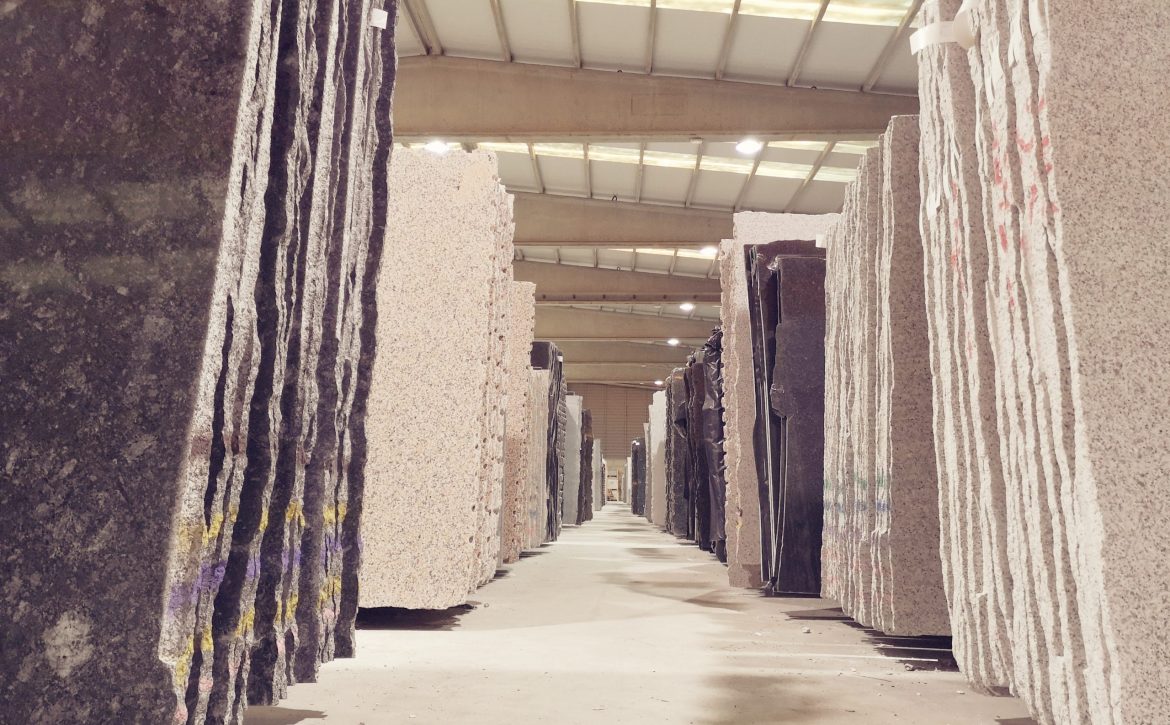
Once the granite has been loaded, it is transported to the factory where the blocks are cut to the sizes and finishes required for each of our projects.

26 July, 2021 by Grupimar 0 Comments

New trends in Urban planning

Despite of the fact that in the last year due to the pandemic and the advantages that remote-working gives us there’s more and more people that are taking chances and going back to rural; according to United Nations in its study “World Urbanization Prospects”, in 2050 about 6,700 million people will live in urban areas, that’s 60% of world population. This is why a sustainable urban planning model is needed today, with the capacity to generate social integration, well-being and at the same time create economic opportunities for its inhabitants.

The challenges that society has had to face over the past year due to the current health crisis have prompted cities to seek innovative solutions within their own capacities, needs and objectives.

Trends in urban planning are increasingly global, ecological and inclusive. Next, we present the most outstanding ones.

SmartCity

The SmartCity concept has been used for some years now, and is presented as a city where technology is at the service of citizens.

Some of the advantages it brings is automation in the management of urban infrastructures, which makes it more efficient, reduces energy consumption and costs, and improves services, mobility and citizen safety.


Sustainable cities

According to studies, energy consumption in cities will account for around 75% and greenhouse gas emissions will reach 80% of the total. Taking these figures into account, it is necessary to find tools to optimise resources, both in the services themselves and to tackle serious problems derived from energy consumption.

Although the search for alternatives in the sustainability of cities has been going on for many years, in the last year there has been an increase in social and political awareness for change and the focus has been placed on the adaptability and flexibility of cities in which the health of citizens is the main concern.


Green Cities

The main objective of the creation of green cities is to design cities with plenty of natural spaces and cultivated land in order to mitigate pollution, lower gas emissions, reduce noise pollution levels, construct sustainable buildings and educate the population to respect the environment.

In terms of street furniture, a commitment is sought to develop durable and resistant furniture, using natural materials such as stoneor wood, recycled or limiting energy consumption. At the same time, it is also sought that this furniture generates the least possible impact on people, for example, with the use of circadian lighting.


Mutable interventions

These are variable interventions, whose nature changes depending on the need or the moment. The most commonly used is street furniture that can change its location or shape. These are flexible urban plans, designed to last in the long term, but which at the same time allow the elements to be modified as the years go by, thus adapting to the needs of the citizens.


Adapting to our elders: collaborative housing

The world’s increasingly ageing population requires new needs to improve the lives of the elderly in cities. Therefore, more than ever, a sustainable, healthy and inclusive urban planning model is needed, with furniture adapted for everyone.

More and more cities are opting for cohousing or collaborative housing, where, in addition to adapting private homes to their needs, housing developments are created with common services, open-air spaces, with direct communication with health services, promoting respect and social inclusion at all times.

Cohousing seeks to end the isolation experienced by many older people by fostering solidarity, neighbourhood support and creating an active community based on trust.

26 July, 2021 by Grupimar 0 Comments

Grupimar participates in the largest private real estate project in United States history

Grupimar participates in the largest private real estate project in United States history Grupimar participates in the largest private real estate project in United States history. We are talking about the new Hudson Yards neighborhood in New York, on the West Side of Midtown Manhattan, bounded roughly by 30th Street in the south, 43rd Street in the north, the West Side Highway in the west, and Eighth Avenue in the east. The hippest neighbourhood in the largest US metropolis is also known as the Far West Side.

It combines office space and luxury residences in six high-rise buildings with entertainment, art and its own school.

Grupimarwas part of this project by supplying more than 2,000 m2 of Azul Platino and Blanco Cristal granite flamed tiles, from Marma S.L. quarriesin Madrid and Extremadura.

We have gone to check first-hand the Azul Platino and Blanco Cristal flamed slabs that Grupimar supplied for the first phase of the Hudson Yards megaproject in New York. We are proud to be part of the Public Square and Gardens with our own granite”, the company shared on its social networks.

nor
26 July, 2021 by Grupimar 0 Comments

Leaders in the granite sector

Grupimar is part of the MARCELINO MARTÍNEZ Group, leader in the granite sector for more than 50 years.

The company started with the extraction and commercialization of raw natural stone and nowadays it owns 20 operational quarries.

In the 90’s, GRUPIMARwas set up as company in charge of the manufacturing and commercialization of elaborated granite.

Taking into account our large production capacity and the professionalism of our team, at GRUPIMARwe maintain our commitment to customer satisfaction, being able to provide a high quality product in tight delivery times and at highly competitive prices, key factors in our success in both the national and international markets. We have a wide range of national and international granites.